Gary Valle's Photography on the Run
Images taken on trail runs, and other adventures, in the Open Space and Wilderness areas of California, and beyond. All content, including photography, is Copyright © 2006-2011 Gary Valle. All Rights Reserved.
Page 1 of 11 in the weather category Next Page
# Friday, January 27, 2012

Rain brings out the richness of the chaparral, enlivening its inhabitants, enhancing its colors, and enriching its fragrances. But in recent weeks rain storms have been few and rainfall far below normal.

The 2011-2012 rain season started out well enough. Thanksgiving Day the water year rainfall total for Downtown Los Angeles (USC) was about an inch above normal. But between Thanksgiving and Christmas the drier weather often associated with La Nina conditions became predominant, and water year totals dropped to about normal.

Northern and Central California were actually much drier than would be expected during a La Nina. Mammoth Mountain recorded no new snow between December 5 and January 19 -- about a month and a half! Our dry spell was nearly as long. Downtown Los Angeles recorded no measurable rain between December 17 and January 21.

The storms Saturday and Monday added about 1.3 inches of rain, boosting the water year rainfall total to 5.06 inches. As of yesterday this was 1.87 inches below normal and about 73% of the normal total.

The problem is this time of year we fall behind another 0.12 to 0.15 inch every day that it doesn't rain. The deficit adds up quickly and if -- as the medium range models currently project -- we don't get any rain for the next 10 days we'll down another inch and at about 64% of normal. We'll see!

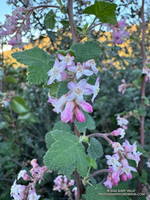
The photograph of the Ceanothus trunk is from last Sunday's Will Rogers - Temescal loop trail run.

Related posts: The Color of Rain II, The Color of Rain

Friday, January 27, 2012 1:29:15 PM (Pacific Standard Time, UTC-08:00)  #   
# Thursday, January 05, 2012

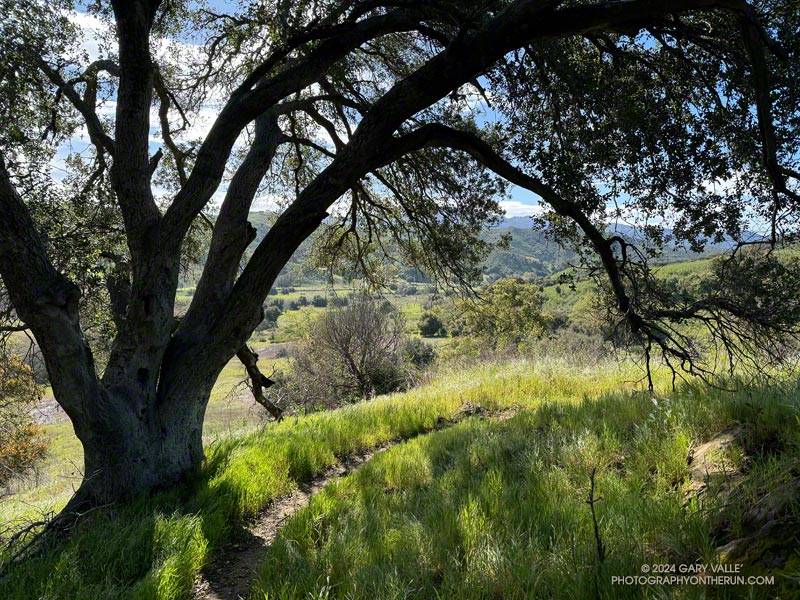
Valley oaks and clouds near sunset

These valley oaks have dropped their leaves, but if you were to go by the warm temperatures we've been having in Southern California, you might think it was Summer.

Including today, the high temperature at Pierce College in Woodland Hills, California has reached into the 80s each of the last six days. High temperature records for December 31 - January 5 have been broken at several locations. Among the records broken, yesterday San Gabriel recorded a high of 91, Camarillo 90, and UCLA 89.

It sounds sweltering, and it can be if you're in full sun, but it's not like a 90 degree day in July. Days are short, shadows long, and some north-facing slopes never see the sun. And it does cool down quickly. If you take a look at the overnight lows on those six 80+ days at Pierce College, you'll see the temperature dropped to around 40-42 degrees.

On my run Tuesday afternoon, when the photograph of the valley oaks was taken, the temperature varied by as much as 20-25 degrees between some high and low points.

It has been great weather for running, but I'm ready for a change in the pattern and a little rain!

Thursday, January 05, 2012 3:04:02 PM (Pacific Standard Time, UTC-08:00)  #   
# Tuesday, November 29, 2011

Round-bottom clouds

Spotted these unusual clouds while running in Upper Las Virgenes Canyon Open Space Preserve today. Better known as Ahmanson Ranch, the open space area is on the western margin of the San Fernando Valley, northwest of Los Angeles.

The clouds were strikingly similar to clouds I'd photographed last January following the development and dissipation of a band of mid-level mammatus clouds over the San Fernando Valley. As before, the clouds were round-bottomed and were ragged with virga.

Upper air charts and model analyses indicated the clouds were at an altitude of about 20K-25K, and were associated with a very small scale upper level disturbance.

Here's a wider view of the clouds.

Related post: Mammatus Clouds Over the San Fernando Valley, More posts...

Tuesday, November 29, 2011 1:59:40 PM (Pacific Standard Time, UTC-08:00)  #   
# Saturday, November 26, 2011

This morning did the Boney Mountain north side loop with Tom and Elisa, who were visiting from Idaho.

Thanks to a moderate offshore flow, visibility from the high point at the top of the ridge (2900'+) was spectacular.

Anacapa and Santa Cruz Island loomed nearby, their eastern shores only 25 to 30 miles away. To the left of Exchange Peak and about 50 miles distant, the low silhouette of Catalina seemed to hover above the shimmering ocean. A little more to the east and about 40 miles away, Palos Verdes Peninsula jutted from behind Sandstone Peak and into the Pacific.

To the north and northeast Hines Peak (27 miles) and Cobblestone Mountain (33 miles) were prominent. A little further to the east and across I-5 Liebre Mountain and Burnt Peak (44 miles) could be seen.

Many of the peaks of the San Gabriel Mountains were easily seen, including Mt. Baldy about 75 miles to the east.

The distance winner was Mt. San Jacinto, a hard to see smudge in the haze on the eastern horizon, about 130 miles away.

Saturday, November 26, 2011 9:15:28 AM (Pacific Standard Time, UTC-08:00)  #   
# Saturday, November 12, 2011

Kern River near the finish of the 2011 Burger Run

The Burger Run is one of those runs that is much more difficult than its 14.5 miles and 2000' of elevation gain would suggest. For one thing the Whiskey Flat Trail ain't no namby-pamby city trail. It's a rustic single track trail in the Southern Sierra that runs along the Kern River from the outskirts of Kernville up to Johnny McNally's Fairview Lodge and Restaurant -- and burger stand.

The trail is single track all of the way, with so many ups and downs you'll think you're riding a Magic Mountain roller coaster. It seems around every corner there is another creek or a ravine. The running is varied and technical, ranging from sweet pine-needle-lined stretches of trail to gnarly, V-rutted, overgrown, rocky, sandy, steep sections that test your trail running skill.

For a time it looked like a big low moving down the coast might cause some weather problems, but overnight rain turned to partly cloudy skies race day morning, with near perfect weather for the runners and walkers.

Many thanks to race director Mike Lane, all the volunteers, McNally's, Indian Wells Brewing Company, and all of the friendly hikers and runners. Proceeds from the race benefit Run 4 A Way, a local non-profit group dedicated to enhancing the fitness and well being of the local youth. Results and finish line photos are posted on Run 4 A Way's Facebook page.

Here's an interactive Google Earth browser view of the Burger Run course and an elevation profile generated in SportTracks. Following are a few additional photos. Click for a larger image:


Aid Station #1

Sock'em Dog Rapid

Steep Climb

Runner, River & Road

Kern Peaks

Ten Miles In
Saturday, November 12, 2011 7:39:22 AM (Pacific Standard Time, UTC-08:00)  #   
# Saturday, October 22, 2011

I don't say this very often, but it was great to be running on pavement -- smooth, even, consistent pavement. All I had to do was put one foot in front of the other and chug on down the blacktop.

I was running down Valley of the Falls Drive from the Vivian Creek trailhead to the Momyer Creek trailhead after ascending San Gorgonio Mountain (11,499'). San Gorgonio is the highest peak in Southern California, the nearest higher peaks being Charleston Peak (11,916') west of Las Vegas, and Olancha Peak (12,123') in the Sierra Nevada.

Saturday, October 22, 2011 2:11:40 PM (Pacific Daylight Time, UTC-07:00)  #   
# Friday, October 14, 2011

What a difference a week makes! Last week an unseasonably deep upper level low, unusually strong 170+ kt Pacific jet, and associated cold front combined to produce record-setting rainfall and cool temperatures in Southern California. This week high pressure and a weak offshore flow produced triple digit temperatures in some areas and set new high temperature records Wednesday in Downtown Los Angeles, Long Beach and Santa Barbara.

Which pattern is more likely this rain season? Will Southern California tend to be drier like this week, or wetter like last week and last year? Despite last year's wet rain season, wet La Nina Winters are not the norm. Generally, La Nina conditions result in drier than normal rain seasons in Southern California, and El Nino wetter.

Following a Summer respite La Nina conditions have reemerged in the equatorial Pacific, and appear to be consolidating. Equatorial SST anomalies have continued to decrease and now range from -1.5°C at 100°W to -0.5°C at 170°E. Equatorial Pacific temperature cross sections show substantial subsurface cooling from July 11 to September 11. The Multivariate ENSO Index (MEI) has dropped from -0.5 for July/August to -0.8 for the August/September season. This drops the MEI from a rank of 16th for July/August to 13th for August/September since 1950. This is well within La Nina territory but weaker than last year's rank of 1st for August/September.

A precipitation composite for seven years* since 1950 in which La Nina conditions persisted or reemerged in the year following a first year La Nina indicates that "on average" the coastal Southern California climate division recorded about 5 to 6 inches less precipitation than normal for the period November through March. The percent of normal water year rainfall recorded at Downtown Los Angeles (USC) ranged from a low of 47% (1971, 7.17"), to a high of 106% (1955, 16.00"). The average rainfall for these years was 70.5%, or 10.7".

We'll get the official NOAA/CPC outlooks next week around October 20, when CPC's Three-Month Precipitation Outlooks and NOAA Winter Outlook are expected to be released.

*The years included in the selection were 1950-51, 1955-56, 1962-63, 1971-72, 1974-75, 1999-2000 and 2008-09. The base period was 1971-2000. The selection was based on the MEI.

Friday, October 14, 2011 7:44:57 AM (Pacific Daylight Time, UTC-07:00)  #   
# Sunday, October 09, 2011

Mt. Baden-Powell from Inspiration Point

The viewpoint above is a few hundred yards up the Pacific Crest Trail from Angeles Crest Highway at Inspiration Point. Craig and I had paused near the start of our trail run from Inspiration Point to Islip Saddle to check out the view. 

The mountain across the way is Mt. Baden-Powell (9,399').  Three miles away as the bird flies, our earthbound route along Blue Ridge, down to Vincent Gap, and then up the forty-something switchbacks to the top of the peak would total around nine miles. From the top of the peak it would be about eight miles to Islip Saddle.

Zooming in on the peak, the white arrow marks the location of the Wally Waldron Lodgepole Pine. For more than a millennia this grand tree has stood high on this mountain, resisting the strongest of winds and the most perfect of storms. Not all are so durable. A lodgepole pine feet away from the Wally Waldron tree was toppled in a storm last Winter.

Given the short-sleeve weather, the most unexpected discovery on today's run was ice under the trees just up the ridge from the Wally Waldron tree. The ice had been deposited on the trees a few days before, when an unseasonably strong storm set a new rainfall record for the date in Los Angeles.

The running on the PCT between Mt. Baden-Powell and Islip Saddle was outstanding and the views superb. Along the way we did the short climb to the top of Throop Peak, checked out the Mt. Hawkins Lightning Tree, and enjoyed the cold spring water at Little Jimmy Spring.

Some related posts: Perils of Winter, Surprises of Summer; Wally Waldron Lodgepole Pine; PCT from Inspiration Point to Islip Saddle

Sunday, October 09, 2011 9:49:14 AM (Pacific Daylight Time, UTC-07:00)  #   
# Monday, September 05, 2011

Mt. Baldy Run to the Top Registration Area and Start

Somewhere around the junction of the 210 and 605 I saw a flash of lightning to the south. As if the flash had been a warning, a gust of wind buffeted my car, and a blizzard of dust and debris blew across the freeway. Then it started to rain. Not good -- especially when you're on your way to a race that ends on top of a 10,000' mountain.

Monday, September 05, 2011 2:46:39 PM (Pacific Daylight Time, UTC-07:00)  #   
# Monday, August 29, 2011

Craig Kinard running on the PCT near Cirque Peak

The Cottonwood Pass - New Army Pass loop is a longtime favorite that I try to do at least once a year. There's nothing quite like running at 11,000' through a forest of gnarled foxtail pines -- some perhaps a thousand years old -- then working up a glacier sculpted basin to one of the higher passes on the Sierra crest.

The trail run is the closest high altitude loop to Los Angeles that is almost entirely over 10,000'. Although its 21 mile length and 3400 'elevation gain/loss appear relatively moderate from an ultrarunning perspective, keep in mind it is a high mountain run that reaches an elevation of 12,300', and includes 12 miles that are over 11,000'. Nearly three miles are above tree line. It's kind of like driving to the top of Mt. Baldy and then starting your run from there.

This year a record-setting snowpack pushed back the date the loop could be done (as a trail run) to late July. I'd hoped to do it two weeks before the Mt. Disappointment 50K, but thunderstorms and flash floods quashed that plan. The next opportunity to do the loop was on Saturday, but once again thunderstorms were in the forecast.

A look at the SWFRS Bald Mountain #5 web cam midday Saturday confirmed the sketchy weather. The camera showed developing clouds from Olancha Peak on the south to New Army Pass, Mt. Langley and Mt. Whitney on the north. We wanted to enjoy the run in short-sleeves and shorts, so postponed the run to today.

And today the weather was perfect! A plus was that Saturday's rain had dampened the sometimes sandy and dusty trails, improving their condition and refreshing the landscape.

One of the interesting aspects of the run was that patches of snow remained from last Winter's heavy snowpack. Not only were there patches of snow on New Army Pass, and elsewhere above 12,000', but there was snow in lower, more exposed locations such as on the southeast-facing slopes above Chicken Spring Lake. Much of this high altitude snow will carryover into this Winter.

Here's a Google Earth browser view and elevation profile of a GPS trace of the loop. The view can be zoomed, tilted, panned, etc. Additional info, a slide show, and more photos are available in previous posts about this loop.

Some related posts: Cottonwood - New Army Pass Trail Run, Cottonwood - New Army Pass Loop, Mt. Langley in a Day from L.A., Climate Change and the Southern Foxtail Pine

Monday, August 29, 2011 11:57:01 AM (Pacific Daylight Time, UTC-07:00)  #   
# Monday, August 22, 2011

Golden Gate Bridge and Fog

From Friday's run to Fort Point and the East Battery.

Monday, August 22, 2011 9:12:25 AM (Pacific Daylight Time, UTC-07:00)  #   
# Friday, August 19, 2011

Golden Gate Bridge and Fort Point

It was great to be cold. Cold instead of hot. Wishing I had gloves. The wind, chill and mist. So different than chugging up Edison Road...

Friday, August 19, 2011 3:29:03 PM (Pacific Daylight Time, UTC-07:00)  #   
Page 1 of 11 in the weather category Next Page